You’ve both said yes, your families are happy, and the date is close. The nikah itself is often shorter and simpler than people expect, and knowing what will happen makes the day calmer. Here is what it involves, and what to sort out beforehand.
What makes a nikah
Scholars set out a few essentials. Ask your imam about the details, because the schools differ on some of them.
- Both of you agree. Freely, with nobody pressured. Her consent is required, as the Prophet ﷺ taught.
- Her wali. The majority of scholars require her wali for the nikah to be valid; the Hanafi school differs. We’ve written about the wali’s role in more detail.
- Two witnesses. Trustworthy adult Muslims. Schools differ on who may be a witness, so check with your imam.
- The offer and the acceptance. Ijab and qabul: a clear offer and a clear acceptance, in the same sitting, in front of the witnesses.
- The mahr. Agreed between you, and best named in the contract. Here’s what the mahr is and how to agree it.
Before the day
- Agree the mahr, prompt and deferred, and write it down.
- Choose your witnesses and make sure they can come.
- Book the imam or the centre, and ask what documents they need.
- Plan the legal registration (see below). It is easy to forget.
On the day
- The khutbah. The imam usually begins with the khutbah al-hajah, the sermon the Prophet ﷺ taught for occasions like this (narrated by Abdullah ibn Mas’ud, recorded by Abu Dawud and Tirmidhi), with verses on mindfulness of Allah.
- Consent and the mahr. The imam confirms that both of you agree, and confirms the mahr.
- Ijab and qabul. The offer is made, often by her wali, and the groom accepts in clear words, in front of the witnesses.
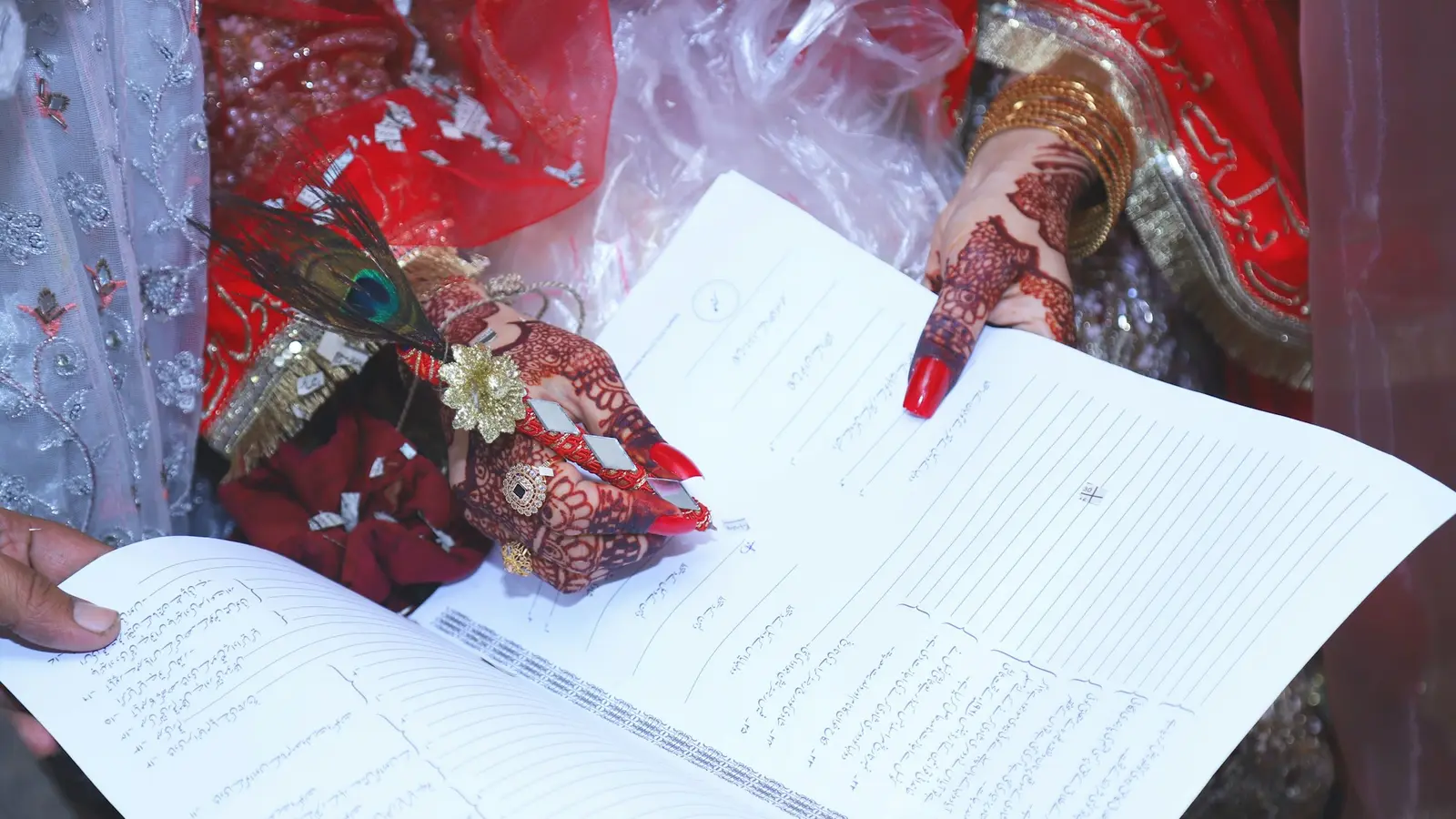
- Signing. The contract is signed by the couple, the wali and the witnesses.
- The du’a. Everyone makes du’a for the couple, often with the words the Prophet ﷺ used himself:
«بَارَكَ اللَّهُ لَكَ وَبَارَكَ عَلَيْكَ وَجَمَعَ بَيْنَكُمَا فِي خَيْرٍ»
"May Allah bless you, shower His blessings upon you, and join you both in goodness."
The Prophet ﷺ, narrated by Abu Hurayrah, Tirmidhi
The walimah
«أَوْلِمْ وَلَوْ بِشَاةٍ»
"Hold a wedding meal, even if only with one sheep."
The Prophet ﷺ, narrated by Anas ibn Malik, Bukhari and Muslim
The walimah is the wedding meal the husband gives to share the news and the joy. The Prophet ﷺ said this to Abdur-Rahman ibn Awf when he married: celebrate, even simply. It doesn’t need to be lavish, and it’s more blessed when it isn’t a burden.
The legal side, in England and Wales
This is the step couples most often miss. In England and Wales a nikah on its own isn’t usually a legally recognised marriage. Unless it takes place in a building registered for marriages, with an authorised person present, you’ll need to register a civil marriage as well, before the nikah or soon after it. It protects you both, particularly the wife, if anything ever goes wrong. Scotland and Northern Ireland have their own rules, and your mosque can tell you how it works there.
May Allah bless your marriage and join you both in goodness.
This article is general guidance written by the Align team, not a fatwa. For your own situation, speak to a scholar or the imam at your local mosque.